
Reliable fibre optic solutions
What is a fiber optic cable?
A fiber optic cable is a data transmission line in which signals are transmitted in the form of light through glass or plastic fibres. Fiber optic cables, also known as glass fiber cables, enable high bandwidths and long ranges, ideal for modern industry and IT networks.
The term glass fibre cables is often used in everyday life. Strictly speaking, this is a special type of fiber optic cable whose fibres are made of glass. However, the generic term "fiber optic cables" covers all cables that use light-transmitting fibres as a transmission medium - regardless of the material.
Fiber optic cable expertise from LAPP at a glance
Discover the complete fiber optic portfolio from LAPP Download our brochure now and quickly find the right solution for your project.
Why is that important?
Fiber optic cables are the basis of modern fiber optic networks. They enable high data transmission rates and stable connections in Industry, IT and telecommunications. Those who understand their role can choose the right technology for future-proof networks.
Would you like to find the right solution straight away? With our fiber optic configurator, you can configure the perfect assembly for your application in no time at all.

How is a fibre optic cable constructed?
The structure of a fibre optic cable, or more precisely the structure of the fibre, determines its performance. It basically consists of three main components.
Structure in brief:
- Coating (coating and colour coding if necessary): Protects the fibre from mechanical influences
- Cladding (sheath): Ensures total reflection and keeps the light in the core
- Core: Conducts the light signal
The functional principle is based on total internal reflection. Light signals are guided in the core by being reflected at the interface to the sheath. This is possible because the refractive index of the core is higher than that of the sheath. As a result, the light remains in the core and can be transmitted almost loss-free over long distances.
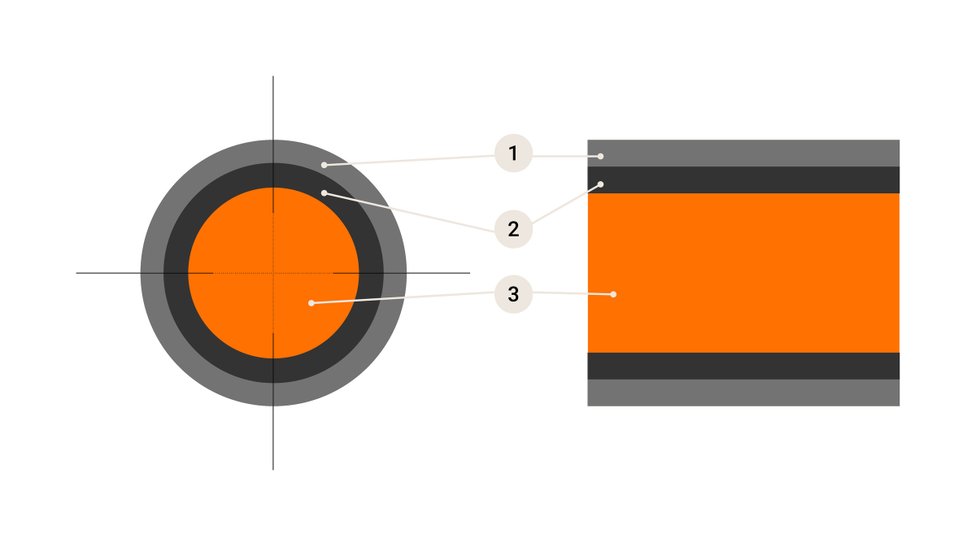
Structure of a fibre optic cable (transverse and longitudinal section
Standards for structure and fibre types:
Fibre optic cables comply with international standards such as IEC 60794 and ITU-T recommendations for glass fibres, including G.652/G.657 for single mode. These standards define the physical properties of the fibres, their areas of application and the relevant mechanical test methods.
Why the structure counts
How efficiently light signals are transmitted depends on factors such as the core, sheath and coating. These influence range, bandwidth and robustness – crucial for performance in demanding environments.
Note: The exact structure may vary depending on the fibre type (POF, PCF, GOF). Details can be found in the next section.
Fibre types at a glance: POF, PCF and GOF
Choosing the right fibre optic cable is crucial for the performance of your network. We basically distinguish between three fibre types:
- POF (Polymer Optical Fibre) – plastic fibre
- PCF (Polymer Cladded Fibre) – plastic-coated glass fibre
- GOF (Glass Optical Fibre) – glass fibre
Each type has specific properties and areas of application. The following overview will help you with your selection.
| Fibre type | Material | Reichweite | Bandbreite | Typische Anwendung |
|---|---|---|---|---|
| POF | Plastic (PMMA) | Short distances (up to approx. 50 m) | up to 100 Mbps | Control cabinet, cable chains |
| PCF | Glass fibre with plastic sheath | Medium distances (up to approx. 100 m) | up to 100 Mbps | Industry, factory networks |
| GOF | Glass (quartz glass) | Long distances (up to approx. 40 km) | up to 40 Gbps | Data centres, FTTH/FTTC, backbone |
Single-mode, multi-mode & fibre categories at a glance
There are two basic operating modes for fibre optic cables:
Single-mode: Fibres with a very small core diameter (approx. 9 µm). They transmit light with virtually no signal distortion and are ideal for long distances and maximum bandwidths, e.g. in backbone or FTTH networks.
Multi-mode: Fibres with a larger core diameter (50 or 62.5 µm). Here, light signals can take several paths simultaneously, which limits the range, but is ideal for short to medium distances in data centres or industrial plants.
These operating modes are divided into so-called fibre categories in international standards: OS stands for Optical Single-mode, OM for Optical Multi-mode. These categories indicate the transmission rates and distances for which the respective fibre is designed.
Do you want a solution that is ready for immediate use? With our fibre optic cable assemblies, you get a plug & play solution from LAPP.
What are the differences between SC and LC connectors?
SC and LC connectors are the most commonly used connectors for fibre optic cables, but differ in terms of design and area of application:
LC connector (Lucent Connector)
- Design: Compact, 1.25 mm ferrule
- Port density: High
- Typical applications: Data centres and high-density environments
SC connector (Subscriber Connector)
- Design: Larger, 2.5 mm ferrule
- Port density: Low, requires more space
- Typical applications: FTTH and enterprise networks
Standards for connectors
Both connectors are available for single-mode and multi-mode fibres. They comply with international standards:
- IEC 61754-4 for SC
- IEC 61754-20 for LC.
These standards define dimensions, tolerances and compatibility for industrial applications. The choice depends on space requirements, existing hardware and desired port density.
Would you like to select the right connectors directly? Discover our range for a secure and standard-compliant connection.
What is the difference between fibre optic cables and copper cables?
Fibre optic cables and copper conductors differ fundamentally in the way they transmit data:
- Fibre optic cables transmit data as light signals via glass or plastic fibres.
- Copper conductors transport electrical signals via electrons.
These differences have a direct impact on speed, range and susceptibility to interference, which are crucial for choosing the right technology.
Advantages of fibre optic cables compared to copper conductors
- Higher bandwidths: Fibre optic cables offer significantly higher bandwidths of up to 60 THz per fibre. This makes them ideal for data-intensive applications such as Industry 4.0 and data centres.
- Long ranges: They enable long ranges of up to 40 kilometres without amplifiers and signal conditioners, which reduces hardware costs and installation effort.
- Low susceptibility to interference: Fibre optic cables are insensitive to electromagnetic influences. This means that communication remains secure and interference-free even in environments with high currents.
- Compact design: The cables are compact and lightweight, which simplifies installation and reduces installation costs.
- Interception security: Optical signals are difficult to intercept, which increases data security for critical applications.
Disadvantages of fibre optic cables compared to copper conductors
- No transmission of auxiliary power: Unlike PoE (Power over Ethernet), no energy is transmitted via fibre optic cables. Active components therefore require a separate power supply.
- Signal conversion required: Optical signals must be converted into electrical signals for intermediate storage or amplification, which requires additional hardware.*
- Complex assembly: Special splicing robots are sometimes required for connection and installation, which increases the effort involved. **
*Note: Our SFP modules in combination with our SFP-compatible ETHERLINE® ACCESS Switch take over the conversion of the optical signals. This means that you do not need any additional hardware.
**Note: Use our connectors with FFC system and do without a special splicing robot.
Comparison table: Fibre optic vs. Copper
| Criterion | Fibre optics | Copper |
|---|---|---|
| Speed | Very high data transmission rate thanks to large bandwidth and low attenuation | High data transmission rate, but limited bandwidth and higher attenuation |
| Bandwidth | Very high (up to 60 THz) | Limited |
| Range (without repeater) | Up to 40 km | a few 100 m |
| Susceptibility to interference | No EM interference | High susceptibility to EM interference |
| Costs | Higher initial costs, but often cheaper for long distances | More favourable for short distances, higher costs for long ranges |
What does this mean for your planning?
With fibre optic cables, you can ensure future-proof networks, avoid signal interference and benefit from maximum performance – crucial for Industry 4.0, data centres and FTTH applications.
Expertise from LAPP:
Would you like to delve deeper into the decision between copper and glass fibre cables? In our specialist article "Cable technology in comparison" you can find out more:
- Which technology is right for your application
- How transmission rate, distance and EMC differ
- Practical tips for planning and installation
Where are fibre optic cables used?
Today, fibre optic cables are indispensable for modern data transmission and are used in numerous industries and applications.
Our solutions for your application
At LAPP, we offer fibre optic cables for almost every industry and application. Our range includes:
- Halogen-free, oil-resistant and heat-resistant cables for use in demanding environments.
- Different sheathing materials for indoor and outdoor installation.
- Assembled and field-attachable solutions for maximum flexibility.
- Accessories and tools for quick and safe installation.
Your added value: You receive everything from a single source for future-proof networks and maximum performance.
What do you need to note when selecting a fibre optic cable?
Choosing the right fibre optic cable is crucial for the performance and reliability of your network. To find the right solution, you should consider the following criteria:
Important selection criteria:
- Area of application: Indoor or outdoor installation, static or in moving applications.
- Ambient conditions: Temperature, humidity, chemical exposure.
- Fibre type: POF, PCF or GOF – depending on range and bandwidth.
- Operating mode: Single-mode or multi-mode, including fibre categories.
- Connectors: LC, SC and other common types, customised to the existing hardware.
- Maximum distance: From a few metres up to 40 km.
- Data transmission rates: From 100 Mbps to 40 Gbps.
Why this is crucial for your infrastructureThe right choice prevents network failures, reduces installation costs and ensures that your infrastructure remains future-proof.